SD3.5 Large에 의해 생성된 FLUX AI 이미지
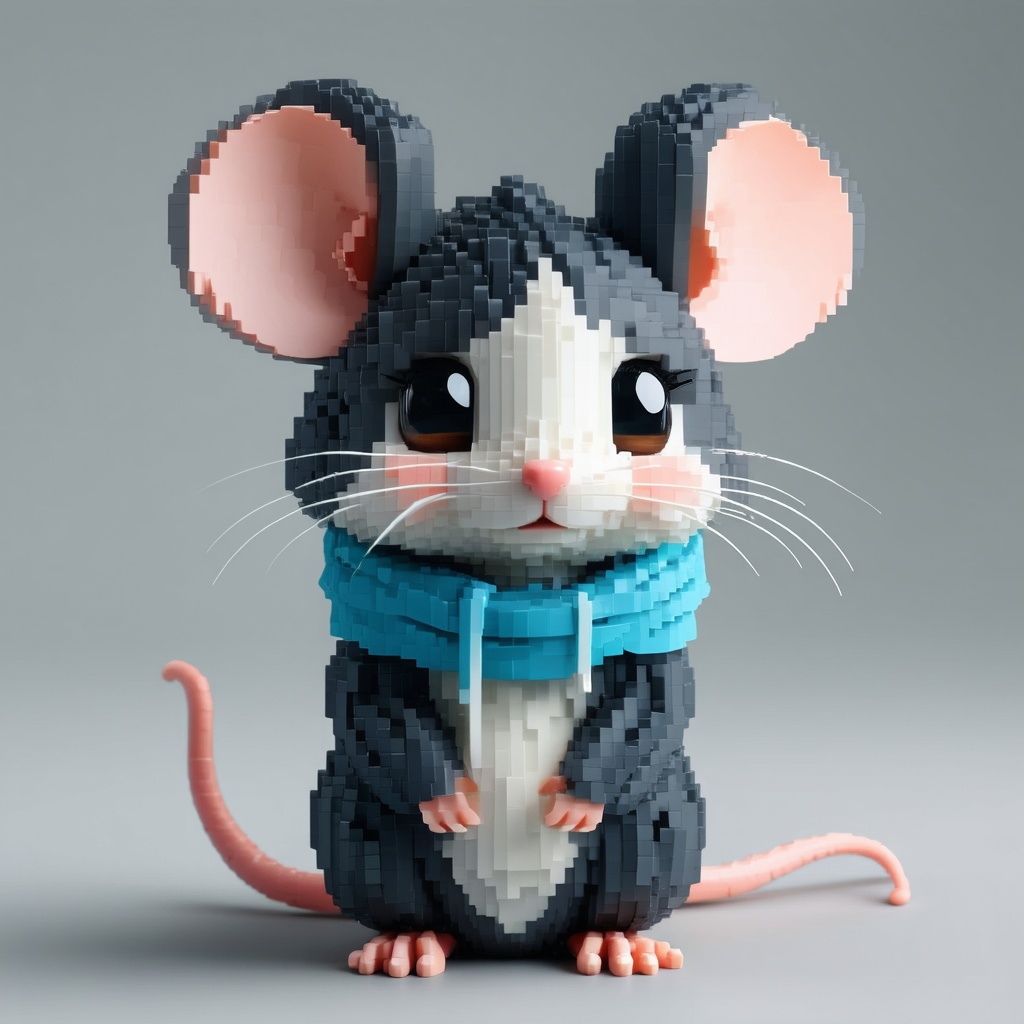
Create a cute voxel-art mouse , full body, centered, 3/4 view facing right, eye-level camera, toy-like proportions, consistent production style.

STYLE GOAL:
- single-character studio render
- adorable chibi silhouette
- body built from clean uniform voxels
- face features styled like polished character decals / smooth feature inserts, matching the reference look
- result must feel like the same collectible series across all animals

COMPOSITION / CAMERA:
- one subject only
- full body fully visible
- centered in frame
- 3/4 view facing right
- eye-level camera
- subject fills about 70–80% of canvas height
- keep even negative space around silhouette
- no cropping

HARD NUMERIC BOUNDING BOX:
- build the animal inside a strict 64x64x64 voxel cube
- longest visible animal dimension should occupy about 48 voxels
- acceptable occupancy range is 44–52 voxels
- maintain internal padding for silhouette readability
- nothing extends outside bounding box, including ears, fins, tentacles, tail tips, antennae, horns, wings, claws

VOXEL DENSITY LOCK:
- voxel faces visually read as about 10 px each at 1024 output
- all body voxels must be uniform size
- no micro-voxels
- no voxel smaller than 8 px apparent size
- no mixed density anywhere on the body
- silhouette and surface readability must remain chunky and clean

FORM:
- head-heavy chibi proportions, approximately 60% head and 40% body mass unless species requires slight adjustment
- compact toy-like silhouette
- rounded voxel masses only
- no thin fragile anatomy
- limbs or equivalent appendages must feel thick, sturdy, and simplified
- small appendages must be at least 3 voxels thick at the base
- preserve species recognition through primary shape, not tiny details
- prioritize big readable forms first, species cues second, micro-accuracy last

FACE FEATURE PASS (NON-VOXEL):
- eyes and mouth are NOT constructed from voxels
- eyes and mouth must be rendered as smooth polished character features inset onto the voxel head
- keep them crisp, clean-edged, and high resolution
- no blocky voxel-built eyes
- no voxel-built mouth
- no pixel staircase on pupils or mouth line
- facial features should look like glossy toy-style inserts or decal-quality facial appliqués placed onto the voxel model

EYE STYLE LOCK:
- oversized rounded glossy black eyes
- strong white catchlights, 1–3 per eye
- soft deep navy or blue secondary reflections are allowed inside the black eye
- eyes should be symmetrical, cute, and emotionally warm
- eyes should be larger than realistic anatomy, but consistent with the reference examples
- eye shape should be smooth oval to rounded-circle, not square
- no eyelashes unless species-specific and extremely minimal
- no angry, sleepy, or realistic eye styling
- avoid uncanny realism

MOUTH / NOSE STYLE LOCK:
- mouth is tiny, simple, smooth, and graphic
- use a very small cute mouth mark, tiny smile, tiny beak line, or tiny species-appropriate muzzle line
- mouth must remain minimal and secondary to the eyes
- nose or beak tip may also be smooth/non-voxel if needed for the same cute style
- do not build mouth from cubes
- do not use teeth, gums, tongue, or realistic mouth detail unless essential and still highly simplified
- keep expression friendly, innocent, and collectible

FACE PLACEMENT:
- face sits on a simplified front plane of the head
- eyes placed low enough to feel cute, but not infant-distorted
- keep mouth and nose compact and centered
- cheeks may include tiny soft blush accents if appropriate
- minimal facial noise
- no extra linework, pores, whisker dots, wrinkles, or realism

SPECIES TRANSLATION RULE:
- convert real animal anatomy into a cute collectible version
- preserve only the most recognizable species traits
- exaggerate head, face, and primary silhouette
- reduce anatomy complexity
- remove unnecessary realism
- every species must still look like it belongs to the exact same product line

SURFACE SYSTEM (SELECT EXACTLY ONE BASE TYPE):
1. FUR (short / typical mammals):
- directional voxel clumping, not noise
- strand groupings 1–2 voxels wide
- strands follow natural growth direction
- cheeks use downward grouping
- slight overlap for depth
- strand tips taper via stepped voxel breakup
- max depth 2–3 voxels
- reduce detail on torso and large masses
- fur defines secondary forms, not visual noise

2. WOOL (sheep, alpaca, etc.):
- clustered rounded voxel clumps, not strands
- clump size 2–4 voxels
- soft puffed forms with gentle stepping
- minimal directional flow
- depth 1–2 voxels
- prioritize volume over texture

3. FEATHERS (birds):
- layered voxel plates, not strands
- chest uses soft rounded layering
- wings use structured stepped layers
- crest or tufts use minimal breakup
- depth 1–2 voxels
- avoid noisy edges

4. SCALES (reptiles, fish with visible scale feel):
- imply scale texture through grouped voxel color blocking
- use repeating 2–3 voxel cluster logic
- no individual micro-scales
- no high-frequency tiling
- keep surfaces chunky and readable

5. SMOOTH SKIN (dolphin, whale, frog, hippo, etc.):
- clean rounded voxel forms
- subtle stepped contouring only
- no clumping behavior
- no strands
- no noise
- prioritize primary massing

6. SHELL / HARD SURFACE (crab, beetle, turtle shell):
- clean segmented voxel plates
- hard readable edges
- minimal breakup
- stepped contouring for curvature
- depth 1–2 voxels max

7. GELATINOUS (jellyfish, soft marine):
- smooth rounded voxel forms
- very minimal breakup
- soft stepped contouring only
- appendages thick and readable
- no strands
- no noise
- no wispy transparent effects

PATTERN RULES (IF APPLICABLE):
- patterns must be voxel bands, patches, or clusters
- minimum pattern width 2–3 voxels
- patterns must follow body curvature logically
- no thin striping
- no pixel-level detail
- no high-frequency noise
- no realistic tiny spotting
- prioritize iconic pattern read over biological accuracy

DETAIL CONTROL:
- all body surface detail limited to 1–3 voxels depth from base form
- preserve clean silhouette edges
- avoid noisy or broken outlines
- do not let surface texture overpower the main silhouette
- simplify small species aggressively so they still match the set

ANATOMY SAFETY RULES:
- for tiny-legged animals, legs may be merged or simplified into chunkier supports
- for tentacles, tails, antennae, whiskers, fins, or ears, thicken and simplify them
- no hair-thin or thread-thin forms
- no fragile floating details
- keep all appendages readable at thumbnail size

MATERIAL / RENDER STYLE:
- body uses flat shaded voxel faces with crisp hard edges
- face features may be smooth and glossy but must remain simple and graphic
- no realistic fur shader
- no subsurface scattering
- no glass material except eye gloss impression
- no painterly texture
- no photoreal rendering

LIGHTING:
- soft studio lighting
- bright clean presentation
- subtle directional light from upper front
- gentle form separation only
- do not use dramatic rim lights
- do not use colored lighting
- keep lighting consistent across all animals in the set

RENDERING:
- hard crisp voxel edges on body
- no smoothing on voxel geometry
- no blur
- no gradient blending across voxel faces
- no anti-aliased mush on silhouette
- face features may be smooth but must stay crisp and sharply integrated
- no visible compression artifacts

COLOR:
- bright controlled palette
- strong face-focused contrast
- shading on body achieved through stepped value grouping, not airbrushed gradients
- keep palette simple and toy-like
- avoid muddy colors
- use slightly higher saturation on focal areas like cheeks, fins, ears, beak, or nose when appropriate

OUTPUT (STRICT):
- 1024x1024 PNG
- true RGBA transparency
- no background color
- no ground plane
- no cast shadow
- no ambient occlusion bloom
- no halo
- no white fringe
- no stray pixels
- single isolated character only

CONSISTENCY LOCK:
- must match a reusable collectible voxel series style
- identical camera logic, scale logic, face logic, and render logic across species
- species changes should affect anatomy, silhouette, palette, and surface system only
- everything else remains locked

STRICT REJECTION:
- reject voxel-built eyes
- reject soft blurry body edges
- reject mixed voxel densities
- reject micro-detail
- reject noisy surface texture
- reject background
- reject shadows
- reject painterly or soft 3D rendering

즉각적인

Create a cute voxel-art mouse , full body, centered, 3/4 view facing right, eye-level camera, toy-like proportions, consistent production style. STYLE GOAL: - single-character studio render - adorable chibi silhouette - body built from clean uniform voxels - face features styled like polished character decals / smooth feature inserts, matching the reference look - result must feel like the same collectible series across all animals COMPOSITION / CAMERA: - one subject only - full body fully visible - centered in frame - 3/4 view facing right - eye-level camera - subject fills about 70–80% of canvas height - keep even negative space around silhouette - no cropping HARD NUMERIC BOUNDING BOX: - build the animal inside a strict 64x64x64 voxel cube - longest visible animal dimension should occupy about 48 voxels - acceptable occupancy range is 44–52 voxels - maintain internal padding for silhouette readability - nothing extends outside bounding box, including ears, fins, tentacles, tail tips, antennae, horns, wings, claws VOXEL DENSITY LOCK: - voxel faces visually read as about 10 px each at 1024 output - all body voxels must be uniform size - no micro-voxels - no voxel smaller than 8 px apparent size - no mixed density anywhere on the body - silhouette and surface readability must remain chunky and clean FORM: - head-heavy chibi proportions, approximately 60% head and 40% body mass unless species requires slight adjustment - compact toy-like silhouette - rounded voxel masses only - no thin fragile anatomy - limbs or equivalent appendages must feel thick, sturdy, and simplified - small appendages must be at least 3 voxels thick at the base - preserve species recognition through primary shape, not tiny details - prioritize big readable forms first, species cues second, micro-accuracy last FACE FEATURE PASS (NON-VOXEL): - eyes and mouth are NOT constructed from voxels - eyes and mouth must be rendered as smooth polished character features inset onto the voxel head - keep them crisp, clean-edged, and high resolution - no blocky voxel-built eyes - no voxel-built mouth - no pixel staircase on pupils or mouth line - facial features should look like glossy toy-style inserts or decal-quality facial appliqués placed onto the voxel model EYE STYLE LOCK: - oversized rounded glossy black eyes - strong white catchlights, 1–3 per eye - soft deep navy or blue secondary reflections are allowed inside the black eye - eyes should be symmetrical, cute, and emotionally warm - eyes should be larger than realistic anatomy, but consistent with the reference examples - eye shape should be smooth oval to rounded-circle, not square - no eyelashes unless species-specific and extremely minimal - no angry, sleepy, or realistic eye styling - avoid uncanny realism MOUTH / NOSE STYLE LOCK: - mouth is tiny, simple, smooth, and graphic - use a very small cute mouth mark, tiny smile, tiny beak line, or tiny species-appropriate muzzle line - mouth must remain minimal and secondary to the eyes - nose or beak tip may also be smooth/non-voxel if needed for the same cute style - do not build mouth from cubes - do not use teeth, gums, tongue, or realistic mouth detail unless essential and still highly simplified - keep expression friendly, innocent, and collectible FACE PLACEMENT: - face sits on a simplified front plane of the head - eyes placed low enough to feel cute, but not infant-distorted - keep mouth and nose compact and centered - cheeks may include tiny soft blush accents if appropriate - minimal facial noise - no extra linework, pores, whisker dots, wrinkles, or realism SPECIES TRANSLATION RULE: - convert real animal anatomy into a cute collectible version - preserve only the most recognizable species traits - exaggerate head, face, and primary silhouette - reduce anatomy complexity - remove unnecessary realism - every species must still look like it belongs to the exact same product line SURFACE SYSTEM (SELECT EXACTLY ONE BASE TYPE): 1. FUR (short / typical mammals): - directional voxel clumping, not noise - strand groupings 1–2 voxels wide - strands follow natural growth direction - cheeks use downward grouping - slight overlap for depth - strand tips taper via stepped voxel breakup - max depth 2–3 voxels - reduce detail on torso and large masses - fur defines secondary forms, not visual noise 2. WOOL (sheep, alpaca, etc.): - clustered rounded voxel clumps, not strands - clump size 2–4 voxels - soft puffed forms with gentle stepping - minimal directional flow - depth 1–2 voxels - prioritize volume over texture 3. FEATHERS (birds): - layered voxel plates, not strands - chest uses soft rounded layering - wings use structured stepped layers - crest or tufts use minimal breakup - depth 1–2 voxels - avoid noisy edges 4. SCALES (reptiles, fish with visible scale feel): - imply scale texture through grouped voxel color blocking - use repeating 2–3 voxel cluster logic - no individual micro-scales - no high-frequency tiling - keep surfaces chunky and readable 5. SMOOTH SKIN (dolphin, whale, frog, hippo, etc.): - clean rounded voxel forms - subtle stepped contouring only - no clumping behavior - no strands - no noise - prioritize primary massing 6. SHELL / HARD SURFACE (crab, beetle, turtle shell): - clean segmented voxel plates - hard readable edges - minimal breakup - stepped contouring for curvature - depth 1–2 voxels max 7. GELATINOUS (jellyfish, soft marine): - smooth rounded voxel forms - very minimal breakup - soft stepped contouring only - appendages thick and readable - no strands - no noise - no wispy transparent effects PATTERN RULES (IF APPLICABLE): - patterns must be voxel bands, patches, or clusters - minimum pattern width 2–3 voxels - patterns must follow body curvature logically - no thin striping - no pixel-level detail - no high-frequency noise - no realistic tiny spotting - prioritize iconic pattern read over biological accuracy DETAIL CONTROL: - all body surface detail limited to 1–3 voxels depth from base form - preserve clean silhouette edges - avoid noisy or broken outlines - do not let surface texture overpower the main silhouette - simplify small species aggressively so they still match the set ANATOMY SAFETY RULES: - for tiny-legged animals, legs may be merged or simplified into chunkier supports - for tentacles, tails, antennae, whiskers, fins, or ears, thicken and simplify them - no hair-thin or thread-thin forms - no fragile floating details - keep all appendages readable at thumbnail size MATERIAL / RENDER STYLE: - body uses flat shaded voxel faces with crisp hard edges - face features may be smooth and glossy but must remain simple and graphic - no realistic fur shader - no subsurface scattering - no glass material except eye gloss impression - no painterly texture - no photoreal rendering LIGHTING: - soft studio lighting - bright clean presentation - subtle directional light from upper front - gentle form separation only - do not use dramatic rim lights - do not use colored lighting - keep lighting consistent across all animals in the set RENDERING: - hard crisp voxel edges on body - no smoothing on voxel geometry - no blur - no gradient blending across voxel faces - no anti-aliased mush on silhouette - face features may be smooth but must stay crisp and sharply integrated - no visible compression artifacts COLOR: - bright controlled palette - strong face-focused contrast - shading on body achieved through stepped value grouping, not airbrushed gradients - keep palette simple and toy-like - avoid muddy colors - use slightly higher saturation on focal areas like cheeks, fins, ears, beak, or nose when appropriate OUTPUT (STRICT): - 1024x1024 PNG - true RGBA transparency - no background color - no ground plane - no cast shadow - no ambient occlusion bloom - no halo - no white fringe - no stray pixels - single isolated character only CONSISTENCY LOCK: - must match a reusable collectible voxel series style - identical camera logic, scale logic, face logic, and render logic across species - species changes should affect anatomy, silhouette, palette, and surface system only - everything else remains locked STRICT REJECTION: - reject voxel-built eyes - reject soft blurry body edges - reject mixed voxel densities - reject micro-detail - reject noisy surface texture - reject background - reject shadows - reject painterly or soft 3D rendering

치수

1024 x 1024

씨앗

15268002112710160000